The OMV Titles ATVs, Not the Wildlife Department
It's a common source of confusion for many off-road enthusiasts in Louisiana: when you buy an ATV or UTV, where exactly do you go to get it titled? Many folks mistakenly think the Louisiana Department of Wildlife and Fisheries (LDWF) handles this, given their involvement with hunting licenses and WMA access, but the truth is, all off-road vehicle titling in our state falls under the purview of the Office of Motor Vehicles (OMV). This guide is here to clear up that widespread misunderstanding and walk you through the correct path to titling your machine.
Understanding the Key Agencies in Louisiana ATV/UTV Titling
Navigating the bureaucracy around your off-road machine can feel like a maze, especially when you're trying to figure out which government agency does what. It's easy to assume that because an agency like the Department of Wildlife and Fisheries deals with so many aspects of outdoor recreation, they'd be the ones to title your ATV or UTV. However, in Louisiana, the lines are drawn a bit differently, and understanding these distinctions is crucial to saving yourself time and frustration.
The Office of Motor Vehicles OMV and Its Role
When it comes to official vehicle records, licenses, and titles, the Office of Motor Vehicles (OMV) is the undisputed authority in Louisiana. This applies not just to cars, trucks, and motorcycles, but also to our beloved ATVs and UTVs. Think of the OMV as the central hub for anything that needs a formal government record of ownership, registration, or licensing, even if that vehicle won't be hitting public roads. They are the keepers of vehicle identity, ensuring every machine has a clear paper trail, from the manufacturer all the way to its current owner.
Their role extends to collecting sales tax, verifying VINs, and processing all the paperwork that establishes legal ownership. This means that whether you've just bought a brand-new quad from a dealer in Shreveport or picked up a used side-by-side from a private seller down in Houma, your first official stop for ownership documentation will always be an OMV office. They're equipped to handle all the intricacies, from verifying proof of sale to issuing your official title document, a crucial piece of paper that proves your ownership and allows you to legally operate the machine.
Beyond just issuing the initial title, the OMV is also where you'll go for any subsequent changes to that title, such as adding a lienholder if you financed your purchase, transferring the title when you sell the machine, or obtaining a duplicate title if yours ever goes missing. They maintain a comprehensive database of all titled vehicles in the state, including off-road machines, making them the singular point of contact for anything related to your ATV or UTV's legal status. Understanding this primary role of the OMV will eliminate a lot of guesswork and ensure you're always heading to the right place for your titling needs.
The Louisiana Department of Wildlife and Fisheries LDWF – What They Do Do
While the OMV handles titling, the Louisiana Department of Wildlife and Fisheries (LDWF) has a very different, but equally vital, role in the world of off-road riding, particularly if you enjoy hunting, fishing, or simply exploring Louisiana’s vast natural beauty. The LDWF is primarily responsible for the conservation and management of the state's natural resources, wildlife habitats, and fisheries. This includes setting hunting and fishing seasons, managing wildlife management areas (WMAs), and enforcing wildlife and boating regulations.
So, why the confusion? It’s understandable. Many riders frequently interact with the LDWF for hunting licenses, WMA access permits, and adherence to various rules when they're out in the woods or on the water. Given that ATVs and UTVs are so often used in these very activities, it’s a natural leap to assume the LDWF would also handle their registration or titling. However, their purview focuses on the activity and the environment, not the specific vehicle itself, unless that vehicle is directly used for regulated activities like hunting game retrieval, and even then, their role is about permitting use, not proving ownership.
For example, if you plan to ride your ATV on a Wildlife Management Area, you might need a WMA access permit or a [Louisiana Self-Clearing Permit Steps] from the LDWF, and you’ll certainly need to follow their specific rules regarding machine size, tire type, and seasonal restrictions. [Louisiana WMA Riding Rules for Quads] But these permits and rules are about how and where you can use your machine on their managed lands, not about who legally owns it. Their enforcement officers might check for a WMA permit or ensure you're adhering to trail rules, but they won't be checking your title or issuing one.
Why This Distinction Matters for ATV/UTV Owners
Getting your ATV or UTV titled correctly is more than just jumping through bureaucratic hoops; it's about establishing clear legal ownership and avoiding potential headaches down the line. When you mistakenly believe the Department of Wildlife and Fisheries handles titling, you're setting yourself up for unnecessary delays and frustration. Understanding the distinct roles of the OMV and LDWF isn't just a matter of knowing who to call; it fundamentally shapes how you approach the entire process of becoming a legal owner of an off-road machine in Louisiana.
Avoiding Wasted Trips and Frustration
Imagine packing up all your sensitive purchase documents—your bill of sale, perhaps a manufacturer's statement of origin (MSO), your photo ID, and all those other papers—and driving a good distance to a local LDWF office, only to be told they can't help you title your brand-new side-by-side. You've just spent precious time, gas, and energy on a wasted trip. This scenario isn't uncommon, and it's precisely why understanding the specific functions of each state agency is so important for ATV and UTV owners.
The OMV is equipped with the necessary systems and trained personnel to process vehicle titles, handle lien recordings, and ensure all state taxes and fees are properly collected. The LDWF, on the other hand, is focused on environmental conservation and regulating activities like hunting and fishing. Their staff and systems are simply not set up to manage vehicle titles. Walking into an LDWF office with your ATV titling paperwork would be akin to going to the Department of Health for a fishing license; it’s just not their bailiwick. Knowing in advance that the The OMV Titles ATVs, Not the Wildlife Department means you can go directly to the right place, whether that's your local OMV branch or, in some cases, a public tag agent authorized by the OMV.
Beyond the initial titling, this distinction matters for future interactions as well. If you ever need a duplicate title, or wish to transfer ownership when you sell your machine, or even record a lien for financing, you'll always be dealing with the OMV. Misdirection can lead to significant delays, especially if you're up against a deadline, like the [Louisiana's 30-Day Decal Deadline] for affixing your off-road decal. Save yourself the headache and confirm the OMV as your destination for all title-related inquiries.
Navigating the Titling Process Correctly
Successfully titling your ATV or UTV in Louisiana requires a clear understanding of the OMV's procedures and what documents they need from you. It's not just about showing up; it's about showing up prepared. The OMV has a very specific checklist for titling any vehicle, and off-road machines are no exception. They are looking for a clear chain of ownership and proof that all applicable taxes have been paid. This process begins with the critical step of demonstrating that sales tax has been accounted for. [Louisiana Requires Proof of Sales Tax First] Without this, your title application simply won't proceed, regardless of how complete your other documents might be.
For a brand-new machine purchased from a dealer, the OMV will require the original Manufacturer's Statement of Origin (MSO). This document is essentially the "birth certificate" of your ATV or UTV, proving it's never been titled before and was legitimately manufactured. [Louisiana Requires an MSO for a New Machine] Dealers usually handle much of this initial paperwork for you, including submitting sales tax and MSO to the OMV. However, when buying a used machine from a private seller, the process shifts slightly. You'll need the seller's properly assigned title. This means the seller must sign over their existing title to you, indicating the sale date and price. [Louisiana Requires an Assigned Title for a Used One]
This meticulous documentation helps prevent fraud and ensures that the legal owner is properly recorded. It also means that any missing signatures, incorrect information, or lack of crucial documents will bring your titling efforts to a grinding halt. Being prepared means having all these ducks in a row before you even walk through the OMV's doors. A little preparation goes a long way in ensuring a smooth and successful titling experience, securing your ownership without unnecessary delays.
The OMV Titling Process: A Step-by-Step Guide
Once you understand that the OMV is your destination, the next logical step is to prepare for the actual titling process. It can seem daunting, but by breaking it down into manageable steps, you can ensure a smooth experience. Think of it like mapping out your route to a new trail: you need to know what to bring, what forms to fill out, and what fees to expect. Being organized and informed will save you time and stress at the OMV counter.
Gathering Your Documentation
Before you even think about heading to the OMV, it's absolutely critical to gather every single piece of required documentation. Walking in unprepared is a surefire way to end up making multiple trips. For any new ATV or UTV, you'll need the Manufacturer's Statement of Origin (MSO). This document is the ultimate proof that your machine is new and legally ready to be titled for the first time. It usually comes from the dealer and confirms the vehicle's unique identity.
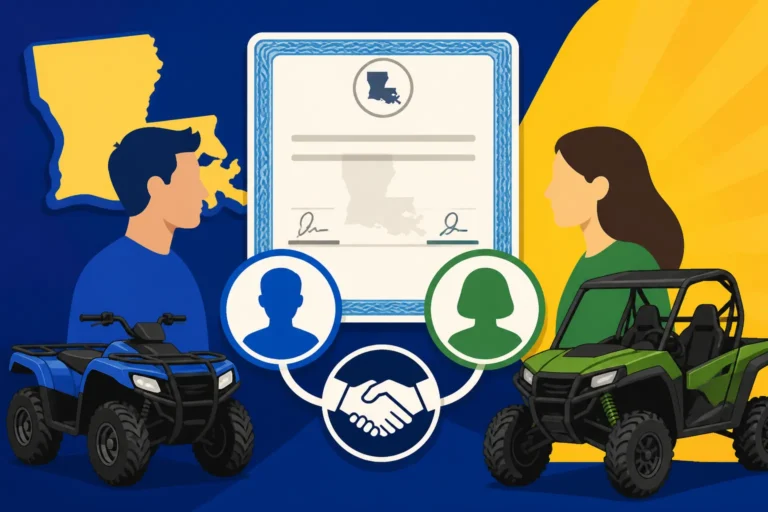
For a used machine bought from a private party, you'll need the previous owner's signed-over title. Crucially, this title must be properly assigned, meaning the seller has filled in all the necessary buyer information, sale date, and purchase price, and signed where indicated. Don't accept a title with any blanks in the assignment section, as this can cause significant issues. Along with the title, a properly executed bill of sale is often required, especially for private party transactions. Many people don't realize that in Louisiana, a bill of sale for an off-road vehicle between private parties needs to be notarized to be legally valid for OMV purposes. [Louisiana Notarized Bills of Sale] This step adds a layer of verification and helps prevent disputes.
Furthermore, you'll need proof that you've paid the applicable Louisiana sales tax. If you bought from a dealer, this will usually be reflected on an itemized dealer invoice. [Louisiana Itemized Dealer Invoices] If you bought privately, you'll either pay the sales tax at the OMV or present a receipt showing prior payment. Don't forget your valid Louisiana photo ID, proof of residency, and the necessary funds for fees. For creating a robust bill of sale, especially when dealing with private sales, online resources like LawDepot can be incredibly helpful for generating legally sound documents that include all the necessary fields for notarization and OMV requirements.
The Application and Fee Payment
With your documents in hand, the next step involves completing the official application and paying the required fees. The primary form you'll be filling out at the OMV is the Vehicle Application, also known as Form DPSMV 1799. This multi-purpose form gathers all the pertinent details about you, the buyer, and your off-road machine, including its Vehicle Identification Number (VIN), make, model, year, and purchase information. Take your time filling this out, ensuring all information is accurate and matches your supporting documents. A simple typo can cause delays! [Louisiana Form DPSMV 1799 Explained]
When it comes to fees, there are a few you'll encounter. The main one is the Louisiana title fee, which is a set amount for processing and issuing your official certificate of title. [Louisiana Title Fee of $68.50] On top of this, the OMV charges a handling fee to cover the administrative costs of processing your transaction. [Louisiana Handling Fee of $8] If you've financed your machine, and a lien is being recorded, there will be an additional fee for that as well.
It's always a good idea to check with your local OMV office or their website for the most current fee schedule before your visit. As for payment, OMV offices typically accept various methods, including cash, checks, money orders, and often credit/debit cards, though card payments may incur a small convenience fee. [Louisiana Title Payment Methods] Make sure you have your preferred payment method ready to complete the transaction efficiently. Having everything prepared, from your forms to your payment, ensures your visit is as quick and painless as possible, getting you that much closer to hitting the trails legally.
What About Decals? Clarifying the Other Key Requirement
Beyond the title, there's another crucial piece of official documentation your ATV or UTV needs in Louisiana: the off-road decal. This is where another layer of potential confusion sometimes arises, as riders might mix up the purpose of a title with that of a decal. While both are necessary for legal operation, they serve distinctly different functions and are issued for different reasons, even though the OMV is involved in both. It's important to understand each one's role to stay compliant and avoid penalties.
Understanding Louisiana's Off-Road Decal
Think of the Louisiana off-road decal as your machine's "license plate" for permitted off-road use within the state. Unlike a title, which proves ownership, the decal proves your machine is registered for operation on designated public lands and trails. It's a requirement under state law for any off-road vehicle operating in Louisiana, ensuring that the machine is recognized by the state for general recreational use. [Louisiana ORV Decals and Titles Explained] This decal helps fund trail maintenance and other programs that benefit the riding community, so it's more than just a sticker; it's an investment in your riding future.
Crucially, the off-road decal is a separate requirement from the title. You can't just have one or the other; your machine needs both to be fully legal for off-road operation in most contexts. [Why an ATV Needs Both a Title and a Decal] The title establishes who owns it, and the decal permits its use on public property. The cost of this decal is very reasonable, typically a small annual fee, making it an accessible requirement for all riders. [How to Get a Louisiana ORV Decal] While the OMV is the primary issuer of these decals, some authorized dealers may also be able to provide them at the time of purchase, making it convenient to get everything done in one go.
Understanding the purpose of the decal helps clarify its importance. It's not about making your machine street-legal – it absolutely does not do that – but about ensuring you're contributing to and complying with the regulations governing off-road recreation. It's a small but significant detail that separates the prepared rider from one who might face an unexpected interaction with law enforcement or a park ranger.
Decal Placement and Renewal
Once you've acquired your off-road decal, the job isn't quite done. Proper placement on your machine is essential for it to be considered valid and easily visible by authorities. The OMV has specific guidelines for where this decal should be affixed, typically on a visible, permanent part of the machine, like the front or rear fender, or another prominent location where it won't be easily obscured by mud, equipment, or your riding gear. It needs to be clear and legible at all times. [Louisiana Decal Placement on a Machine] Failing to place it correctly can lead to the same problems as not having one at all, as it can be difficult for enforcement officers to verify your compliance.
These decals are not a one-time purchase; they operate on a renewal cycle. In Louisiana, off-road decals generally run on a multi-year cycle, meaning you’ll need to renew them periodically, often every few years, to maintain continuous compliance. [Louisiana Decal Cycles and Their Length] It's easy to forget about renewals, especially if you only ride occasionally, but keeping track of your decal's expiration date is vital. The OMV usually sends renewal reminders, but it's always wise to mark your calendar and keep an eye on the expiration date printed directly on the decal.
The consequences of riding without a valid, properly affixed off-road decal can range from a warning to a citation and associated fines. [Louisiana Penalties for No Decal] Law enforcement, especially in areas popular with off-roaders or on public lands, will check for these. It’s a simple requirement that’s easy to fulfill but carries real consequences if ignored. So, once you get that shiny new decal, affix it correctly, and make a note of its renewal date. It's a small step that ensures your adventures remain free of unnecessary legal bumps.
Common Scenarios and How the OMV Helps or Doesn't
Life isn't always straightforward, and neither is vehicle ownership. You might find yourself in a unique situation, such as purchasing a machine without traditional paperwork, inheriting a quad, or bringing one in from out of state. These scenarios can add layers of complexity to the titling process, making it even more important to understand the OMV's capabilities and limitations. Knowing how to navigate these less common paths can save you significant time and frustration.
Dealing with Unique Titling Situations
One common challenge arises when you purchase an ATV or UTV from an out-of-state seller. Each state has its own titling and registration laws, and while the OMV in Louisiana will title an out-of-state machine, you'll need to ensure the prior state's title has been properly assigned or that you have sufficient proof of ownership according to Louisiana's standards. [Louisiana Titles for an Out-of-State Purchase] This often involves proving sales tax was paid in the original state, or paying the difference if Louisiana's rate is higher.
Another situation is inheriting a machine after a family member passes away. This can be emotionally difficult, and the last thing you need is a bureaucratic headache. For inherited machines, the OMV typically requires documents like a death certificate, a will, or an affidavit of heirship to legally transfer the title to the rightful inheritor. [Louisiana Titles for an Inherited Machine] These situations require careful documentation to avoid potential legal issues down the road, and sometimes preparing these affidavits with legal templates from sites like LawDepot can streamline the process.
Perhaps the trickiest scenario is dealing with machines that seem to have no paperwork at all—no title, no bill of sale, just a machine you've acquired. [Louisiana Machines With No Paperwork] This is where the OMV's ability to help becomes more limited. While they have procedures for reconstructed vehicles or those where ownership is murky, it's a far more involved process, often requiring additional sworn affidavits, extensive VIN verification, or even a bond. The OMV needs a clear paper trail to issue a title, and if one doesn't exist, you'll need to work significantly harder to establish it legally.
When to Consult the OMV Directly
While this guide provides a lot of general information, there's no substitute for direct consultation with the Office of Motor Vehicles when you have a specific or unusual titling question. The OMV has various resources available to the public, including detailed websites, phone support lines, and, of course, their local offices. For the most accurate and up-to-date information on fees, required documents for specific scenarios, or policy nuances, reaching out to them directly is always the best course of action.
Before you make that call or drive to an OMV office, it’s always a good idea to gather all the information you have about your machine and your specific situation. This includes the VIN, the year, make, and model, any existing paperwork (even incomplete), and a clear outline of your question or problem. The more prepared you are with details, the better and more accurate assistance the OMV staff can provide. Remember, they deal with a high volume of inquiries, so clarity and conciseness on your part will be appreciated. [Planning an OMV Counter Visit So It Takes One Trip]
Making contact can often clarify complex situations that seem daunting from the outside. They can guide you through the process for unique cases like [Louisiana Titles for an Auction Buy] or address issues like a misspelled name on a document. Their staff are trained to interpret the specific statutes and regulations that govern vehicle titling in Louisiana. Don't hesitate to reach out if you're unsure; a quick call or a well-planned visit can prevent costly mistakes and unnecessary delays, getting you titled and ready to ride quicker than trying to guess the correct process.
| Agency | Primary Role for ATVs/UTVs | Key Activities | What They DO NOT Do for ATVs/UTVs |
|---|---|---|---|
| OMV | Titling & Ownership Documentation | Issue titles, collect sales tax, process liens, issue ORV decals | Manage wildlife, enforce hunting laws |
| LDWF | Wildlife Management & Regulation | Issue hunting/fishing licenses, manage WMAs, enforce outdoor recreation rules | Issue titles, collect sales tax |
Disclaimer
This article is for general informational purposes only and does not constitute professional advice. Laws, prices and regulations vary by location and change over time. Consult a qualified professional for guidance on your specific situation.